Friday, September 25, 2009

Nothing for Itself - Curatorial Statement

Pluralist Paintings, Born in the Middle of Salad

The concept of “nothing for itself” came about in the conversation between representation and diversity. Representative objects are xenophiles, referring away from themselves. The frequency of sexual imagery in this show acts as an attractor towards further replication of people and things. Representation and diversity are organic, and, seeing culture as an ecology, benefit the whole system. At the same time, any individual artwork, and any one of its settings, can be seen as its own system.


The Lower East Side is often described as having both vivacity and diversity, in that there are cultures continually warring each other -- long habituated, although not necessarily superlatively so, to the continual financial encroachment cycle of NYC. There is a particular tendency towards a kind of micro-radicalism, an insistence on artists remaining equally poor but supporting each other within, and in direct resistance to, one of the most purely fiscally motivated geographies in the world.


The city is rich in resources that art needs to reproduce itself – money, and attention. So the image of Nuyorican imagery, since Andy Warhol, is fixated on raw competition, self-awareness, and its own marketability. A kind of continually fulfilled desire for plurality over a gained majority, as with people and groups of people, motivates a democratic culture. Yet moderation, collaboration, or cooperation for its own sake cannot benefit other qualities. Such is the melting pot to the salad. The qualities that attract resources are not necessarily aesthetic, although the concept of considering what takes a greater share of resources aesthetically superior has its own attraction. The qualities of self-aggrandizement and narcissism are strong attractors, and it is a choice to counteract them. Some things will be for their own sake, others for the sake of others, some in a continuous chain, some in loops, all in complicatedly interdependent relationships. Be a nature preserve for endangered ideas.
This is not another gripe about commoditization and the market, nor does it praise it. If it contradicts itself, all the better. Although any solo show exists in a jungle of other art within the same market, the generous aim of diversity in Nothing For Itself permeates fractally within the individual works, artists, painting styles, the show, the neighborhood, the city, the country, the world, and the multiverse.


In the current economic stall, it has become important to develop economies of service and giving to others. JS Flores’s recently executed painting reflects the feeling of the times, of a multitude of desperate people competing for nothing more than your attention. In Allison Moore’s interpretations of images from nearby locales, displays of variety awaiting the choice of the consumer become competitions between the very colors and shapes used to represent them. Like Moore, Bruesselbach dizzies and disorients, to the point of making explicitly depicted human bodies flatten and abstract, in parody of the flattening liquidation of material culture. Talley also uses the most eye-capturing possible images, taken from pornography, and saturated colors appealing to inner and outer children. Yet the compositions are continuous playful processes without the cyclopean vision of traditional representation.


Through three of the four artists, California manifests strongly in this show, particularly the distributed post-city of Los Angeles. Certainly the imagery addresses distinctly American experiences, including two second-generation meso-Americans, a product of secular Jewish matriarchy, and an African-American from D.C.
Desire that by being set with each other, the qualities of any given piece of this show become greater. Hope that they do not necessarily have to fight for themselves. Intend to be for something else, not because it is for itself, but because it is for many others. Or be for something selfish, because agenda forget pluralism. See something else in everything, and take nothing for itself.

Tuesday, September 22, 2009

Nothing For Itself - October at A Gathering of the Tribes

Nothing For Itself
Paintings of Diversity, Born In the Middle of Salad
October 1-31
Opening Saturday Oct. 3rd 6 pm
Tribes Gallery
285 E. 3rd St. 2nd floor
New York, NY 10009

A show of young emerging artists in irrationally exuberant involvement with the city, curated by Janet Bruesselbach with Allison Moore, Jason Talley, and JS Flores


The diversity of these artists emerges in contrast with their similarity. They are occupied both with the human body and with the tactility of paint. Representation gives itself over to the object and submits to an orgy of feedback. This is not art for its own sake, but anything for the sake of anything else. Vivacity is exchange between a body and its environment, and New York in its still-modern postmodernity enlivens our images. Yet we contradict the self-aggrandizement demanded by a capitalized art market, in a continuous chain of promoting others. Chaotic and yet completely intentional, these funnels for desire, their entropy, and the life of objects that they suggest, make for a colorful carnival of the Fall.

Allison Moore generates neo-cubist responses to market environments, in lurid, intoxicated colors and shapes. She's bicoastal.

Jason Talley assembles superbly rendered figures and toys into Freudian-tinged erotic tableau, playing with explicitness and our resistance to it.

JS Flores engages the surface of figurative paintings, mating visual effects with tactility. His figures are warped by their media, giving them a powerful presence. This engages a destructive tension towards human flesh.

Janet Bruesselbach improvisationally composes surreal oil paintings with a playful disregard for gravity and depth, in which everything is figure.

As well as being a vivid image, "born in the middle of salad" is that anti-utopian metaphor of New York not as melting pot but, in the imperfect way of all metaphors, a multi-cultural, multi-directional conglomeration of tastes.

For more information, contact janet@bruesselbach.com / (310) 617-3366


Please come! Tribes is having some financial and anticipating legal difficulties, and for them to stay a Lower East Side institution, Steve Cannon needs your support.

Friday, May 08, 2009

Veritas Odium Parit

means "truth creates hatred".


Oil on linen, 72'x60', 2009. I started with a composite of several photographs of colliding/gravitationally interacting spiral galaxies, then improvisationally found humanoid figures (and some more virtual metaphors) in it, following a spatial structure of in for one galaxy center and out for the other, and finding cool and warm pastel lights in fetal forms. It's seeded by a psychological allegory of resisting attractive forces. Dali claimed that relativistic physics suggested the vacuum was meatspace: matter is not pulled towards other matter but pushed by muscular nothingness.

Also finished:


"Insults as Veiled Compliments", 36"x72", oil and silver paint on linen, 2009.

Almost finished:


"Respect the Autonomy of Inanimate Objects", acrylic underpainting with oils on canvas, 72"x72". Painted in brightly colored glazes, cheesy Richard Corben-style, under Nicola Verlato. I started with a spontaneous drawing and then evolved it through tracings, color studies, clay and digital models, and compositional organization.

Wednesday, April 22, 2009

Works in progress


VERITAS ODIUM PARIT, Oil on linen, 5'x6', as of two days ago. I did a lot more work on it today and anticipate finishing next week. The figures will recede into that yellow galaxy center, and then I'll sort of mosaic-jpg-artifact-censor my least favorite moments.

I'm intending to submit this for the Diploma Exhibition. All are welcome to come to the reception/opening, Monday, May 11th from 6-8 at 111 Franklin St. in Tribeca (between Church and W. Broadway)


Respect the Autonomy of Inanimate Objects, acrylic underpainting on canvas, 6'x6'.
I'm using an odd technique, for Nicola Verlato, with this one in which I've been building up from a small drawing and making models, in clay and Poser, and then painting the whole thing in black and white acrylics before I go over it with space-photo colors. It has been intense, and involved, and queasy. It's the second largest painting I've ever done and the largest was actually the last time I used the same technique.


Several potential titles for this:

The Masochist Seduction Technique
Insults as Veiled Compliments (the little study I did for it can be Compliments As Veiled Insults, a pettier beast)
A Woman A Man Walked By (in tribute to PJ Harvey)

Opinions?

It's 3'x6', oils and silver acrylic on linen.

Friday, April 03, 2009

Janet's Recent Work


"Effect Affect", oil on canvas, 36"x42", March 2009.

In progress still:

VERITAS ODIUM PARIT, oil on linen, 6'x5'.

Tuesday, March 31, 2009

Deterration

This diploma thesis on Deleuzian optics and science studies goes some way towards explaining my influences, and is transformatively informative, too.
(yes, I switched to just a link, because it was too long for a cut, and figuring out cuts was more trouble than I thought it would be. You can't judge me.)

Thursday, March 26, 2009

Panni Malek

website, mostly with work from Otis and illustration.

Panni is an Iranian painter raised in Los Angeles. Her paintings examine female sexuality, celebrating a lush, sensual, elaborate and fussy femininity. She perverts the masculine conceits of high art by embracing not just figurative representation, in warm colors and Sargent-like softness, but of kitsch subjects: kitties, titties,intricate interiors. There is a subversive element in every painting: sex toys, delicate profanity, a certain over-passivity.


oil on canvas, ~20"x30", 2008


(Self portrait in French abandoned house. oil on canvas, ~36"x48", 2008


oil on canvas, ~36"x24", 2008

Saturday, March 21, 2009

Chris Marshall

I'm sorry for the hiatus! Things have been busy.

Marshall paints cool, atmospheric scenes that have the vague quality of childhood memories. Faces and gestures may drift into a blur with backgrounds. Careful elision accentuates an intense nostalgic affect, a sensation of significance without articulable meaning. He uses thin, evidential layers of an earthy, primarily opaque, palette influenced by Odd Nerdrum, with whom he has studied. He recently spent a summer in Leipzig and had an exhibition in Ireland.

All oils on linen, 2008, dimensions not precisely known but around 30"x30":


Saturday, March 07, 2009

Armory Show highlights

Doug & Mike Starn's Amaterasu, a spinning, whirring dynamo, was the brightest feature of the Modern wing on Pier 92. Video selections from their installation last year, Big Bambu, also appeared.

Wei Dong's Chinese appropriations of Western painting:


What I saw of Alexi Worth was a large image of a man handling a woman, but I think I like the couples series even more.
His work carries on the semantic effect of Magritte's surreal clarity with greater stillness and less solipsism.

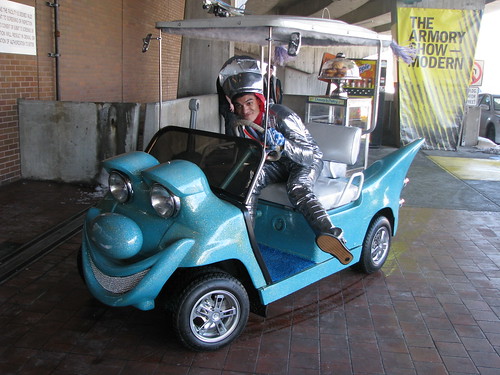
Pop Surrealist Kenny Scharf was the contemporary star of the show, with a mural outside and a friend carting around in a silver suit, just for the goofy mood of it all.

Also, they were giving out doughnuts. WIN.

Lutz & Guggisberg
For my own good, Ryan McGinness:


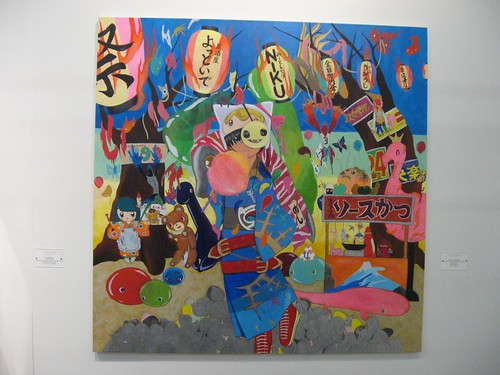
Mahomi Kunikata, "I Wish We Had Never Met, Cock Festival Edition"


The showings were really good from Mizuma from Tokyo.

Sashie Masakatsu:


Ikeda Manabu makes exhaustive pen drawings of landscape-objects. Reminds me of games probably actually derived from him, like Katamari Damacy and Shadow of the Colossus.

"Territory", 2004 pen, acrylic ink on paper, mounted on board 42x59.5cm

Iva Gueorguieva:

Dread Dimple Dawn

Beth Campbell's "My Potential Future Based On Present Circumstances" hit close to home.

It's a decision tree for a starving artist.

Overheard comment on pornographic shower curtains: "it would be really good for someone's funeral."

Tuesday, February 17, 2009

Speculative Introductory Art Syllabus

Note for schools: This syllabus has never been taught, but is intended as an introductory visual art course, admittedly more painting- and Western-oriented, incorporating slide lectures and work critique. It is set to a short semester and can be expanded in weeks 3, 5 and 6 or contracted.
Reading excerpts are about 30 pages a week on average.


Janet Bruesselbach
Inverse Art History & Practice

This course will subvert the causality implied in art history surveys by beginning with the contemporary and ending with the primeval. Noisy pluralism is thus slowly peeled layer by layer down to the most multiply-influential but less physically preserved styles and imagery. Classes will alternate between slide presentations paired with seminar discussions, and active assignments aiming to progressively forget. What if you could only remember the future?
Readings will be emailed or copies distributed the week they are assigned.

Grades: 50% assignments, 40% participation, 10% responsibility

Week 1: The Present. Relational Aesthetics, art as whatever can’t be otherwise defined, Late Capitalist market context. Nominally about something else by being about itself. Read: Jameson.
Assignment: Make/bring an example of what you do next week.

Week 2: Modernism. Negational logic and an aesthetic of taking to extremes. Simplicity and alienation. Read: Greene
Assignment: Make something that desires to be nothing more or less than itself. Think about what the most basic aspects of a visual statement are. Due Week 4.

Week 3: Realism and impressionism; imperialist appropriation. An isolation of perception and a re-observation of the everyday.
Assignment: Make something whose goal is observed representation of reality. Think ambitious, labor-intensive, scientific. Due Week 7.

Week 4: Romantic &. Academic: The beginnings of political modernity. Aiming for the representation of an idea. The dialectic.
Read: Hegel (tbd), Blake’s Marriage of Heaven and Hell.

Week 5: Rococo, Baroque, Mannerist. Art the same as entertainment. Popular and theatrical, art serves those in power: the church, increasingly. Decadence -> drama -> systematized. The significance of light.
Read: Kant (tbd).

Week 6: Early Modern / Renaissance: Exceeding the idealized era. Analysis of space and anatomy, linearity. Read: Panofsky, “Perspective as Symbolic Form”

Week 7: Gothic, Medieval: The submission of the individual to a greater social project and another world to come. Assignment critique.
Assignment: Create a sacred object. Due week 10.

Week 8: Roman: Art made by slaves / owned craftspeople. A multiple, hybrid society, homogenized brutally. Relief/pseudo-space, humanism. Read: Gibbon (tbd)

Week 9: Greek: Hellenic -> Classical -> Archaic. Harmony and the body as measure. Read: Aristotle.

Week 10: Egyptian: permanence, sustainability, timelessness – everything written in stone, taking as much time as necessary. Assignment Critique.
Final Project: visually engage as much history as possible; consider how we understand other times. Consider the present as layered pasts (Palimpsest).

Week 11: Mesopotamian: Hybrid society and the fundamental language of power.

Week 12: Neolithic & Paleolithic: Archetypal forms and the reasons for art. Cave paintings, decorated tools, venuses.

Week 13: Final project critique

Monday, February 09, 2009

Jaclyn Brown

Jaclyn Brown creates a world of nostalgia, satire and dreams with her oils. Viewing this work is like entering into an X-Rated Mary Poppins film, where past, present and future social structures are questioned through absurdity. (Canada, current Graduate student at The New York Academy of Art, 2008 resident of the KW Institute in Berlin, Germany.)
This stuff truly speaks for itself. Darger-like narrative obsessiveness meets female narcissism in Carrollian spaces.


She's featured in Siren's Warning, a show at Artspace in Hartford, next week.
four artists
three countries
new works by women of Generation Y

February 16th – 27th 2009
Gallery Hours: Wednesday, Saturday, Sunday 4-7 pm
Or by appointment at scustance@gmail.com

Opening Reception Saturday the 21st, 7 – 10 PM

Artspace Gallery - 555 Asylum Avenue - Hartford Ct, 06105

Monday, January 26, 2009

Jan Pecarka

Jan is a Slovakian artist whose work examines a scalar confusion of figure and landscape. At first they appeared separately, vast, smooth-seeming pieces of bodies and surfacey land. His best work places bodies on vast geographical scale: a woman waist deep in a planet her own size, a man hovering above a city, a figure either blue or in atmospheric perspective, toes on islands.


about 5'x7', 2008, I think. I just went to his studio and took these pictures because it's not up on his site yet.


He's having a solo show January 29th through February 11th at the Bohemian Benevolent & Literary Association at 321 E. 73rd St (between 1st and 2nd), 3rd Floor, NYC. (212) 988 1733
Reception 6:30 on the 29th. WON'T YOU

Saturday, January 17, 2009

Teaching Philosophy

I feel that theory and practice can be the same, and especially that theory derives from practice. People often become too isolated in their own fields and exclusive about their influences, and don’t realize how much bodily and mental activities create knowledge. Many people shrug off not knowing how to see, as many feel about math. But learning how to represent should be requisite in learning how to think.

The way people think when they've always been about symbol manipulation, and don't think so much about the visual foundation of text, excludes a whole system of thought that may undermine so many biases. The more everyone knows the process of coordination and self-examination involved in visual art, the better – and the more about anything and everything that artists know, the better.

I am continuously learning something new, and part of what I want to teach is that everything artists find interesting is relevant to their thinking and their art: music, culture, the material everyday. Each person is their own universe and I want to encourage my students to keep their universes as open as possible. An ability to communicate and persuade is more critical in society and it’s important to connect it to visual rhetoric, although one of the major changes occurring is a proliferation and acceptance of non-verbal media.

When you've seen how differently everyone in a class depicts something you get a much more explicit illustration of how differently people process sense-input. That is something I aim to have my students recognize.

Janet's Statement

A bit of my own stuff while I work out who's up next and try to persuade people that free advertising isn't going to destroy them.

How is this? Does it match/describe the work well?

My figurative oil painting seeks to allegorize the autonomy of the inanimate object. I celebrate a female multiplicity by arbitrarily ordering disparate and similar images. Sensory overload and interplay between smooth and striated space incite affect. Imagery intuitively derived from science fiction and comic art maintains an amused contrarianism to categorization. Eclecticism induces a decentralized, eccentric perspective out of a mainstream and traditional medium. In search of levity, here is no automatic orientation; everything is both figure and background. The humanoid body, its agency compromised through merging with others, is nevertheless skillfully embraced through a fluid observational style, combining invention and self-representation through a democratic objectivity. Bodies shift colors, reflect and are reflected, both fully permeable and closed. Extremities and contradictions are sought through a hybrid middle ground.

Thursday, January 01, 2009

Cecilia Roberts

is in the class of 2009 and has a website up, although it was last updated in summer 2008, so I'll put up some more recent paintings of hers soon.


Portrait of Mallory, oil on canvas, 2008. Anyone else reminded of Magritte's "Pleasure"?


Portrait of Antonia, oil on canvas, 2008. Antonia is a Greek printmaker and artist from the class of 2008, now working for Jeff Koons.


Self Portrait with Candy and Babies, etching?, 2008.

Cecilia paints intimate portraits that capture the idiosyncracies of personality. They develop out of a process of looking an interacting with her subject and their things, with a kind of improvisational feminist space structured by interest. Both her oil paintings and her prints show a quirky line by a quirky observer.

Tuesday, November 25, 2008

Having finally managed to gain access to this account again, I will be turning this into an art blog featuring students at The New York Academy of Art, and more. Stay tuned!


Janet Bruesselbach, "Portrait of the Artist as Grad Student", Oil on canvas, 28"x62", 2008.