Sunday, June 27, 2010

Census 2

          There was another day of field training under supervision, a meeting of the whole local crew, and then, by the middle of the first week of May, we had all been issued binders for one or two blocks of buildings and the addresses of everyone in those buildings, including the names of those who had already responded by April 15. We could not have another binder until we had completed every questionnaire for the non-responding addresses. We were on our own.

          The immediate obsession of most enumerators is the dreaded Refusal. In that first week there were a fair number of people who'd simply forgotten, neglected or sent in late their mail-in questionnaires. But those that require in-person visits are naturally far more likely to be suspicious and reluctant, and literally the second door I knocked on was an RE. I developed a pleasant persistentness I doubt I could maintain for door-to-door sales - and naturally, since most people are more used to the idea of strangers ringing their doorbells selling something, the first priority was making sure they know that's not what I was. The second was making them understand how little information I wanted and how bound I was not to share it, and sometimes I never got that far. I have a particular personality that's very concerned with the sharing of information, but also feared that this eagerness would be counter-productive. It's an extremely emotionally draining job, with soaring highs and crushing lows and everything in between.

          As reformed in Title 13, the census is deliberately intended to be independent of other data collection, especially the IRS and INS. Not that my saying so will reassure immigrants. All of them must come from somewhere with some form of population estimation, for the determination of geographic vote allotment or otherwise. But the principle of keeping all authorities' hands from knowing what the other hands are doing as a means of protection may be counter-intuitive even - maybe especially - to those raised in the American educational system. And then again, why trust me just because I trust the principle? Bureaucracy too easily is considered to go hand in hand with corruption. The same law that criminalizes my leaking anything within a boundary of paperwork also criminalizes not cooperating with me. Census policy amongst enumerators is to keep most ignorant of this threat, partially because prosecuting is so much harder than allowing a wider statistical margin of error.

          While I have a massively bothersome conscience, it's not that I can't imagine how the census system could be abused. I know that the census materials, seemingly completely innocuous, could be used for identity theft if leaked. What's on the short-form questionnaire can't be use for that, of course, but with a few tweaks you could get social security numbers. It probably wasn't in my interest, but when people used the excuse of having "done it over the phone" or "already sent it back", I was willing to suggest that they hadn't been responding to the real census, especially when we'd finish and they'd ask "that's it?"

          It wasn't particularly useful to take on an air of authority or even dress as well as they wanted us to. I enjoyed the position of authority too much to be utterly casual enough to be asking birthdays innocuously, but approaching that was far more effective than confrontation. Of course, there are many people who respond badly to both chattiness and officiality. Fast=painless was a useful thing to mention when not going by the book, the book being just going straight through the questionnaire.

          One critical limitation was that we ourselves were not a proxy respondent. Information could not be generated by the observations of the enumerators, only by the responses of the interviewee to questions. I find this a very important argument against the all-too-easy The Truth Is Out There model, in which facts already exist before they are recorded. The census form itself carefully delineates the grammatology of facts - who or what counts as a person, and a residence, and an occupant, not to mention gender and race, and the especially fuzzy Hispanic Origin distinction. Any change in the shape these values fit into changes the fact.


Department of Redundancy Department, Ironic Ignorance Division

          Bruno Latour is the source for this kind of post-de-structuralist understanding of the social mechanisms of knowledge. Even looking at the root of "fact", you can see that it's something that is made, arduously. Information does not want to be free. Information wants to be wrong, and countering that entropy demands labor, and anywhere there is labor there is the question of pay.

          It may be easier to think about hard sciences as a collaboration between human, non-human, and hybrid objects when we look at the humanist biases of the census's statistical baseline for social science. Every quantum of personal information intends to be self-identification. Since it's faster to just let an informed respondent (who must be over 14) describe the entire household, this is merely an ideal. Critically, as with the Pirahã language, everything requires a source. At the NRFU stage, this is even limited to only a person that a person working as an enumerator has talked to. There is something very interesting that happens to social interaction when it is ordered by paper and print infrastructure as a means of constructing facts. The strategies of enumerators often aim to downplay this weirdness despite the legal carefulness of official instruction.

The very distinction between social and physical is limned by the human-paper work collaboration called the Census. By limn, I mean that it is a hybrid that creates the boundary by entangling its sides as much as possible. That we are specifically gathering social facts is entangled with way the bureau has defined society as made of humans. Like their lag on computer-based forms, this is one aspect of the census that I want to say makes it outdated in comparison to almost all other statistical sources - but embedded in that criticism is a contradictory The Truth Is Out There Error, as the census makes the understanding of society as without people.

To be continued. Again: questions and comments, please! I'm trying to remember what everyone has been curious about and curiously incurious about. I also need to get more non-identifying anecdotes in here and less generalizations. If you need me to explain some of the more arcane theory here I can do that.

Saturday, June 26, 2010

Census 1

          It was my intention to write from my temporary job this year as a census enumerator from the very beginning. Somehow, I never got any of it written down while it was still fresh in my mind. I'll try to do this narratively, and hopefully that will jog my memory about the procedural and theoretical curiosities. Much like the times I've worked for the Board of Elections, my intention is to emphasize the virtues of bureaucracy, or rather, how a well-organized system of the mostly-ignorant can both generate accurate information and protect individual rights.
          I'm aware that many commentaries are beyond critical of blunders, evils and abuses. Many of these are typical small-scale workplace cynicisms or highlight the gap between planning and execution. I consider both criticism and the things criticised symptoms of a working social measurement machine. On the whole, census employees themselves are cynical and practical if they're not overly eager. I am most critical of the amount that my positive spin is an outcome of training myself to persuade people to respond. It also seems to me that the public news about this has been superficial, uninformative, and passive aggressive, so I also see this as an opportunity to discuss attitudes at a personal level.
          About a month into the job, employees were sent a notice about what they reveal in social media, emphasizing that they must be clear that their opinions are not those of the Census Bureau. Also, of course, reminding them of their confidentiality oath, which I'll get to. I'm not sure whether particular incidents resulted in the reminder. I did tweet briefly while in training with another trainee in Louisiana, and I heard enough to know that the relative sanity and ease of my local operation was the exception to the rule.
          I took the test last summer (quite proudly one of the first to finish it), and got a call a few weeks later saying my score was in the 98th percentile. Good, but easily beaten by anyone with the 5% extra given to veterans. They called me at least twice again asking if I were still available. My response was always yes, but not until the third call did they offer an actual job. Contrary to the expectations I had that the census would require far more office than field work, it is during May's NRFU (Non-Response Follow-Up, pronounced "narfoo" - oh how the government loves its acronyms), a.k.a. door to door interviewing, that the bureau's payroll bloats by a factor of about 4. (I got this information from a news report I now can't find, my deepest apologies.)
          Interestingly, coverage of the census has focused more on the jobs it created and money they government spends on it than on what it actually is. It's interesting to note that, partially because I had scheduled a ten day trip to Germany at the peak of NRFU, I've only made twice as much actually working as I did during the 40 hour training week.

          Only in retrospect, knowing that, do I consider that training week to be rather too long. It seems they hired as many to be trained as possible, expecting to eliminate many of the trainees, and the hiring bloated so much that it was nearly impossible for instructors, themselves only trained the previous week, to even communicate enough with the next level up to get materials and organize field work. It was at this point that I referred to the organizational structure as being nothing like the already-redundant root system of clerks and supervisors provided in our handbooks, but like a katamari ball. Extension of this analogy becomes ridiculous.

          The training location wasn't set until fairly late, and I think our instructor may have been the last to know. Training was in a cram school in Flushing, a 30-minute bus or subway ride from the neighborhood we all lived in and would work in, and the transportation costs were paid. The sardonic instructor, crew leader for half the class, set the attitudes of the more socially attentive of the group. The different supervisor for my area was even more down-to earth. For a highly social job there seemed to be a high percentage of the less socially attentive, so much so that I felt gregarious in comparison. It is, after all, a job for those shaken loose from other jobs, and did not require an interview. I gained about 10 pounds that week thanks to Flushing's pan-Asian deliciousness.
          One major joke that came up was the fact that the government thought to issue us all ballpoint pens for those carbon-paper forms that required them, but blue ones. The fingerprinting required of all Federal employees required black pen. Hilarity, we all carefully agreed. Fingerprinting is regarded as a fine art involving careful choreography. Because the only people available to do the fingerprinting had had a single day of training the previous week, a lot of the fingerprinting had to be redone in the office later in the week with a touch-sensitive machine. Whether the amount of extra time paid to trainees amounted to enough to have bought enough of these machines for all the classes, I don't know. It only occurred to me later that it was especially important to fingerprint census enumerators because the temptation to do a little breaking and entering is strong. It's the momentum of the thing.

          We swore the Oath on the first day. We put our hands over our hearts and swore... jeez, I'll have to look this up. I'm not being paid to write about this, and I made sure to check that I was allowed to leak instructions to enumerators and such (all very boring). The central tenet was that we could not use any of the personal information we gathered for any purpose other than the census. I understand it may still be hard to trust someone based on their taking an oath (I left the "so help me God" part out, even), but there's a quarter million fine threat behind that oath, plus jail time. And again, I'm aware incentives are better than threats - more than aware, after my door-to-door experiences - but we all both took that pledge seriously and thought it a goofy cinch. More on that later.

          Although it at first seemed tedious to go through the many practice questionnaires covering different ways we'd have to fill out the form, the only one I never had to use was the instance of an address that was a vanished trailer on a yard. Even then, I had to do many "deletes" for joined, mislabeled, or under construction homes. I don't know what it is about any classroom situation that turns everyone into a surly teenager uneasy about how they appear to other students, but the reluctance to actually pretend to be performing interviews was stupid. After filling in time with practice, paperwork, and a test one of whose official answers was wrong, we did go "into the field", and discovered that most of it was the repeated writing of Notice of Visit forms. A scourge, as it must be noted as a personal visit, of which we were only allowed three.

Technically we were all supposed to start the day after training, but the mid-managing level understandably delayed that at least two days. Trainees in areas requiring even more enumerators were just left in not-enough-supervisors limbo for a while.

I would like to emphasize that I consider this kind of obvious human frailty combined with persistence of the structure - everyone knew where they were supposed to be getting what, and didn't just go rogue with their badges counting whoever they thought needed counting out of zealousy or institutional mistrust. Discussing problems wasn't penalized, but making problems official was mostly understood to be counterproductive. As an apparatchik, I simultaneously understood myself to be paper's tool, and also knew that paper needed me to be smart and responsible and make empathetic and logical decisions. It's the lack of imagination, the discussion of alternatives without initiative, that keeps the information gathered consistent, and the information-making apparatus predictable. Predictability is not only critical when we see this as demographic science, but also maintains the trust of the people being measured. The census is an extensive self-check whose only goal is thoroughness, above all else.

The next installment will go more into ideology. Is there anything you want to know? Please ask! Also, I'd like to republish this series, or a summary, if you have a blog where I can guest post.

Saturday, June 19, 2010

10 Books

I know I did this one four years ago, and it trended again a year or two ago, and I never really got around to it then, but I've been thinking about what books changed me. Also I just integrated Amazon into the blog so this is kind of a way of testing that "I get a little if you go through me" deal. It's supposed to be just what pops into one's mind at some time, so here, currently, are 10 books that occur to me as being important, in no order:

1. Malcolm X's autobiography. I don't know why this had such an impact. I'm a white chick and he's pretty dismissive of white chicks. Maybe it's the way he implies that any former hoodlum could have the leadership to make a fringe church humanistically righeous, while clearly being the only possible one. Maybe it's the "self-made man" aspect. Maybe it's that halfway through the book he takes Hajj and loses his separatism - it's an example of inconsistent opinion within a single work that makes the work stronger. Alex Haley didn't try to consolidate too much, working as medium, and is brilliant for it. Red's pretty funny too, in a dry, angry way. Too much of mainstream race politics avoids obvious, historical bitterness, that both supports Obama and continues despite him, and is not necessarily symptomatic or problematic.


2. Samuel Delaney - Dhalgren. I think this book took a lot of the uneasiness I felt about sexuality and how it's treated in literature, and turned it inside out. Same with race and class. There's a casual lack of repression, including repression about how it's repression that makes things hot, that I suppose can only come from a writer for whom sex with strangers of all varieties was so normalized. I'll admit I still don't entirely get what's going on with Bellona, or why the book is more science fiction than magical realist meta literature. Probably the temporal paradoxes, the continuous entropy.


Her Smoke Rose Up Forever
3. Julie Phillips - James Tiptree, Jr. (and Tiptree's short story compilation).
I feel a certain kinship with Sheldon, mostly because she considered herself a painter, then an art writer, before joining the army. She's one of my heroes, and to compare myself to her makes me realize how lucky I am for my historical circumstances. She was brilliant, depressive, and indefinably queer before there was a community and politics for such, and only in her age did she begin to see changes that would have made sense of her younger self. Tip's experience of the conservative turn of post-war America made her/him deeply cynical about feminism, with a certain biologically deterministic resignation that serves to question the concept of progress.


4. Donna Haraway - Simians, Cyborgs, and Women
Primarily the essay "A Cyborg Manifesto", which aims to reprogram the language we use about nature, culture, human and nonhuman (and animal and object)in a way that feels like it's been there all along. Perhaps it's a female perspective, but the implication is that not all females will agree and that there's nothing particularly biologically automatic about rhetoric or belief - both of which are immanently physical phenomena. At the same time, I wouldn't say that this approach to animal rights necessarily prescribes a code of action. Nor am I entirely sure the culture of criticality about science can own this, either.


5. Bruno Latour - We Have Never Been Modern
Especially in translation, sometimes you just have to let the nonsense sweep over you and own whatever misinterpretation of it you make. He's thinking about social science, meta-history, and how facts are constructed in democratic collaboration between human and nonhuman members of society. There's a defiance for the objective against post-structuralist relativism while using its rhetorical slipperiness. What I take from it applies to art history and the absurdity of 20th century theory, an understanding of any majority as infinitely complex.


6. Jared Diamond - Collapse
It's not so fresh on my mind as the others but it has to be in here because I still think in terms of wastes of resources, and how to define a society and the decisions it makes. While Guns, Germs, and Steel, despite the complicated research, had a simple and somewhat deterministic thesis, Collapse is not only more thorough but more urgently emphasizes sustainability in the relationship of system and environment. The many contradictions don't overpower the obvious quite enough, and it's more a link between sciences and history than an examination of how those are made (which is what I really like), but it at least overturns what we imagine to be prosperity, civilization, and success.


7. David Foster Wallace - Infinite Jest
What can I possibly say? Take drugs or kill yourself. My sister and I realized that we were way less interested in reading anything after reading this. And it's not that it argues that, or anything. But having an answer that the best answer is always having more questions (which is not the only possible takeaway) kind of spoils you for reading. It changes something.  I'm also pretty much always rereading it because it's in my bathroom.  I don't know what kind of hubris that implies.


8. Michael Pollan - Omnivore's Dilemma
In a few years this won't be in my mind as quite so influential, but it's one of the most impactful books I've read. It makes you think about how food links you to society, and how strong the urge is to not worry about where it comes from. I'm less worried about health issues than the fact that so many cheap calories are basically petroleum.  And again, it's realist.  It recognizes that knowledge does not necessitate practice.


9. The Immortal Life of Henrietta Lacks
This didn't blow me away topic-wise or revolutionize my bio-ethics, which were already made posthuman by previous entries.  It did make me imagine going into science journalism.  It's simply a very good example of the genre, that I've read recently.


10. Thomas Pynchon - V.
Gravity's Rainbow is hot shit, too, but V. is almost the dry run for Gravity's Rainbow, so that what's in the former is almost taken for granted by the latter.  It's a much more intimate, personal pastiche, much more concerned with the problems of desire and the interiority of things.  It's one of those books that influenced a lot afterward, yet is primarily about taking influence from everywhere.  It's about the sexuality of inanimate objects, okay?  Basically making an existentialist-mocking joke of all the modernist literature puzzling over the female other.  It's by the same sort of wanker, but one who emphatically wants the book, in its duplicates and internal separability to speak for itself.

Sunday, June 13, 2010

CAVEAT EMPTOR

CAVEAT EMPTOR FULLY FUNDED!

I am raising money for a tattoo.
UPDATE: spoke to my desired artist, who said it would be $80. Kickstarter disapproves, since I'm not in fact giving you anything back but the thrill of spending. I'll keep updating here with how much you've given:

$80/80


The tattoo will be on the back side of my right forearm near my wrist. It will be very small and read "CAVEAT EMPTOR". Likely it will be in Myriad or a simple all-caps sans-serif at the artist's discretion. I got the idea from Philip K. Dick's Ubik, in which Pat Conley, a young and unusually innocuous (for a female Dick character) psychic history-editor, is mentioned as having the tattoo.

Naturally I do not want to pay for an always-already-regrettable "buyer beware" cheeky consumer awareness permanent reminder with my own wage labor. If you donate even a little bit I will consider it an early birthday present. If I do not get $80 by October 12 I will give you your money back. I want this to be specifically dedicated money rather than associating the event with a particular job.

Thank you very much! Have a nice life.

Sunday, June 06, 2010

Bushwick Open Studios

Look, I had this really great idea. I would crash at a friend's place in Bed Stuy Friday night and then walk around Bushwick visiting friends and art heroes with studios there. This all went exactly according to plan except that I was hung over (I swear, three drinks does not usually do that), it was 90 degrees Farenheit, and 100% humidity. After elbowing into the downstairs neighbors' recovery Rock Band, I attempted to live the Summer in Brooklyn way.
Rapid movement was out of the question. I uneasily digested a cheeseburger and 32 oz. of iced coffee and wandered over to 1717 Troutman. Some NYAA alums had been the first to rent a space in the warehouse-turned-workshop building, and it was great to see them churning out new work, plus all the artists who had moved in since then.

Cecilia Roberts, "Dierdre and a Rat Trap"


Sarah Elise Hall
, "stasis" sculpture

Leelee Chan and Ginny Casey, a couple of recent RISD grads, have studios in the same building. Leelee is doing some great thing with recycled material sculpture, my favorite medium of late.


Jeff Fichera
does extremely closely observed paintings and drawings (from a landscape painting background) of chaotic everyday surfaces.

Jessica Angel uses stencils to make Janet-bait techno-kitch paintings.

Further Janet-bait is Aaron Williams' collaged and constructed uses of space photography.


There were something like 100 other studios besides this big building but I was too knackered to do more than stick my hair under yet another open fire hydrant and nap through my friend's birthday party.

Sustainability as an idea is everywhere but I am still always amazed at how art keeps being made, and therefore leisure time bankrolled, somehow. I know it comes from the idea that beauty is important to have around all the time. I don't want to take that for granted while every grant, mostly unfulfilled, argues it over and over.

There are still things going on today out there so get thee to the Jefferson stop!

Tuesday, June 01, 2010

Portrait median


The median trick with portraits. I deliberately resized and picked ones with about the same figure-to-frame proportions, and still we learn two things:
1. I do not have a compositional formula and mix up poses pretty well.
2. I love alizarin crimson a little too much.

Another thing we learn is that all portraits converge on the Mona Lisa.

Monday, May 31, 2010

Median

There's an article at Shutterstock about how to take a personless picture of a crowded place using Photoshop's statistical scripts. My first thought, of course, is: what happens if you do this with a stack of photos of different things? Are the artifacts it generates interesting?
I have a series of digital drawings I've been making for 10 years, made according to a formula of nude models drawn with colors sampled from a background of satellite space photography. I did this to all 50 of them, and this is the result:

That's pretty cool.
Then I did it to my grad thesis paintings, which don't even have up and down orientations, to see whether I had compositional tendencies with those:

It doesn't really know what to do when you tell it to automatically align things. I'm going to keep playing with this and see if I can get the other statistical options to do anything interesting besides black, white, and gray blocks. There's something fascinating about using a formula made to find signal on noise.

Wednesday, May 26, 2010

résumé

Janet Bruesselbach
janet@bruesselbach.com 69-60 108th St. Apt. 517
(310) 617-3366 Forest Hills, NY 11375
I’m a figurative oil painter, designer, curator and writer looking to join my energy and intelligence with others involved with culture, sustainability, science and technology.
Employment History
2010 Enumerator for the U.S. Census Bureau Non-Response Follow-Up operation.
- Temporary May-June position interviewing at addresses that hadn’t mailed in their decennial census questionnaires. Responsible for keeping personal information confidential, pursuing proxy sources, and working mixed hours on my own schedule.
Supervisor: Danny Weiss, d.aryeh.weiss@gmail.com (917) 214-3027
2009- Curator of A Gathering of the Tribes gallery, 285 E 3rd St. New York, NY 10009 www.tribes.org
- Coordinated with and selected artists for shows in an alternative exhibition space owned by
Steve Cannon. (212) 674-8262
- Art Editor for Issue 13 of A Gathering of the Tribes literary magazine.
2006- Bookseller, Shakespeare & Co., 716 Broadway, New York, NY (212) 529-1330 Rebecca Lambrecht - Retail clerk responsible for friendly customer service, register, shelving, textbooks, stock.
2006-2008 Information Clerk, Board of Elections.
- On election days, I guided voters to their appropriate districts at my local polling site.
Queens Board of Elections (718) 730-6730
2007 Library Assistant, New York Academy of Art. Reference: Kristine Paulus, Kristine@nyaa.edu
2007 Intern, Location One nonprofit arts organization, 26 Greene St., NYC
Steve Cukierski, steve@location1.org, artists Ligorano/Reese
2007 Art Director, Chromed Productions. Game design.
Irfaan Chaudhry, irfaanc@gmail.com; Adam Kenney, adam.kenney@chromed.com
2006 Intern, Society of Illustrators, 128 E. 63rd St. New York, NY 10021 (212) 838-2560
2005-2006 Gallery Installer for RISD Exhibitions, 62 Prospect St.. Providence, RI 02903
Supervisor: Mark Moscone, mmoscone@risd.edu, (401) 454-6141
2004 Intern, Tor Books, 175 5th Ave., New York, NY with art director Irene Gallo, Irene.gallo@tor.com
Education
2007-2009 Master of Fine Arts in Painting, New York Academy of Art
111 Franklin St., New York, NY 10013 www.nyaa.edu
Studied with John Jacobsmeyer, Catherine Howe, Nicola Verlato, Will Cotton, and Kurt Kauper
2002-2006 Bachelor of Fine Arts in Illustration, and Concentration in European History
Rhode Island School of Design (RISD) 2 College St. Providence, RI
1999-2002 Crossroads School for the Arts and Sciences.
21st St. Santa Monica, CA. (310)829-7391 GPA: 3.8 SAT: 720V 710M
Other Education
2005 Summer program in painting and history, Rome, Italy
2004 Summer Art/Technology History class at Columbia, New York, NY
2001-2003 Summer classes in Astronomy, Microbiology, Science Fiction, Baroque Art. UCLA, CA.
2001-2002 California Art Institute, Westlake, CA.
1994-2002 O’Neill Fine Art Studio, Malibu, CA.
Exhibitions & Awards
April 2010 The Girleye Show – Curator of feminist photography exhibition with Beth Hommel, Cassie Olander, Lauren Goldberg and Marie Hansen. A Gathering of the Tribes, 285 E 3rd St. NYC
October 2009 Nothing For Itself at A Gathering of the Tribes, 285 E 3rd St. New York, NY
May 2009 A Figurative Reconstruction, New York Academy of Art, 111 Franklin St, NYC
December 2007 Sebrof International at the New York City Hungarian Cultural Institute
2006 RAINN t-shirt art competition winner
3/2-3/7, 2006 3-Person Senior Show, RISD Illustration Gallery, Providence, RI
May 2005 Burleson Painting Competition, First Place Junior Award
10/28-11/5, 2004 Junior Show (Organizer & Exhibitor), RISD Illustration Gallery, Providence, RI
Skills - Traditional representational painting, photography, instruction in old and new art media
- Gallery administration and maintenance.
- Communication, writing, editing, copy editing, blogging, social media
- Computer game and user interface design, project coordination, graphic design print and web
- Adobe Photoshop, InDesign, Dreamweaver, Microsoft Office , Maya, Mac, Windows, html , css, php

Monday, April 19, 2010

Girleye Show response

Response to Chavisa Woods and Art Less on The Girleye Show.

Thank you for wrapping your superior minds so attentively around this tawdry project. So I think what’s coming together is an awareness of the tension between feminisms. Namely, a contention of how best to address Laura Mulvey’s legacy and the “male gaze”: do we subvert the supposed dominant paradigm by rearranging the organs, or nullify the her mere Freudianism by proliferating the other configurations that had always appeared?
This namely comes to light when A notes that there’s nothing in many of the photographs that indicates authorial gender: “Slowly, we come to understand that it is the essence of the radical (and a slap in the face to both Laura Mulvey and the men whom she rightly criticized) for these photographers merely to portray their subjects with the variegation natural to two (or more) humans playing in the light, linked and loving through a camera lens, and nobody shunned or stopped or subjugated by the process at all.” This is the nullifying side, analogous to moderate feminism, arguing variations of style as genderless. Whereas a radical could say that in order to reveal that such disembodied art inherently oppresses, we must actively pursue unfamiliar forms, we might also claim the paradigm by majority, or reverse the unfamiliar into the canny.
Though not the only strategy, I was drawn sometimes in images to what I knew, not historically specifically, but of the conventional uses of stock photography, the myths it proliferates, and the role of women in generating and managing these images. Part of what I try to get at with “formal queerness” concerns an interest in professional interactions between women. This isn’t necessarily “linked and loving” or without power dynamics and communication errors. It is perhaps related to my interest in understanding what “generic” is to me personally and how it differs from how similar people see it.
So yes, this gets to A’s best point: the collection is regrettably mono-ethnic. It’s unfortunate considering Tribes’s mission of diversity. I’d all too easily turn this into a parody of Stuff White People Like in honest self-defense. I guess I didn’t find any photographers of color, and Marie’s stranger on the subway became a token to highlight the unfair consistency.
To address the other criticism A made, of the subjects’ gender, which she already de-polarized fairly well: the focus of the show narrowed in the making. At first, I was considering photographers of a range of genders, although always addressing feminist issues. Without actually prodding at gender boundaries, we might take femaleness or femininity or whatever the as-opposed-to-what theme is here for granted by limiting it to cisgender. Cassie may have re-titled several photos to negate gender-identified names, hopefully not out of a depersonalizing pressure from me, but to let the androgenous continuum decouple from the models’ names. Even trans men are girls too. My only regret is an accidental exclusion of transwomen.
Perhaps I’m keeping too specific here, and perhaps we’re all happier spared my nitpicking on content and symbol. The show’s faggot-coined shadow title indicates a parodic encouragement of the medium’s (being bodies and cameras and everything that surrounds them) more confrontationally radical interpretations. Yet the actual title is a take on the show-within-the-show (The Girlie Show, sold by the inclusion of a funny black man) on 30 Rock, whose protagonist has lately been the feminist feminists love to hate. Treating a diversification as a simple inversion still invites a complication of the sexual politics involved: Does the subject possess the artist if their autonomy penetrates the lens, as Chavisa suggests? When each image is the evidence of a different reinterpretation of a seemingly limited set of givens, we can see either something only these women could do, or something anyone (or thing!) could do. Is anyone insulted if I’m more excited, and intend more of a compliment, by the second?

Girleye Background by Art Less

GIRLEYE: AN EXPLANATION OF THE TITLE


Walking into the Girleye show at Tribes unprepared, an ordinary viewer might find herself thinking something like, hmmm, Girleye: Women looking at women. But women look at women all the time. We’re sighted creatures. Duh! And what the heck does ‘girleye’ mean anyway? It’s not a word, people.


Would you care for a little background? Good, because you’re going to get a lot.


The Girleye Show was first ever-so-slyly named after a wrongfully cut scene in John Waters’ 1977 film Pink Flamingoes. Mocking Laura Mulvey a scant two years after the publication of her “Visual Pleasure and Narrative Cinema,” Waters wrote (and later, blaming “all the marijuana I was smoking,” discarded):


A lot of people like cunt, you know. Men, women. But your eyes are like a cunt to me, honey. You can look and look and look...and still I wake up wishing you were there... watching me twenty-four hours a day. Them cunt eyes.


Hilarious, right? Especially if, like John Waters as he wrote the infamous monologue, you have smoked too much marijuana. But whatever does it mean? And how does it relate to the Girleye title? (Another answer, the answer to how the monologue relates to the film from which it was excised will not be given by this blog post primarily because, as the scene has been made available to the public, it does not relate to the rest of Pink Flamingoes at all. How very John Waters, and lovingly so . . . )


First things first. There’s more to the humor here than meets the . . . eye. One suspects that, regardless of the author’s herbal proclivities, he finds the scene funny primarily because he himself is an unreconstructed homosexual. Waters will never find cunt desirable, and he will certainly never wake up wishing two vulvas were staring him down twenty-four hours a day. Moreover, almost all human beings (we can safely extrapolate, but if anyone does scientific research to the contrary, I for one would love to know) would be just the slightest smidge disturbed to see vulvas in the place of eyes on any face—male, female, human, nonhuman; it really doesn’t matter. (Maybe this is why the eye of Sauron squicks us out so?) A cunt for an eye, taken literally, implies a uterus for a brain, and that shit just ain’t genetically viable, so it’s going to squick us out. You can go even further with the visualization and reflect that two tiny cunts correctly positioned under the forehead and above the nose will look not unlike an extremely diseased, shut-swollen, pus-leaking, inflamed and lash-plucked pair of eyes currently visible only on the most destitute Third World beggars, and best avoided in any case if you want to keep your lunch. So it’s funny that anybody, even a John Waters character, would want to see eyes that looked like cunts. And this humor should certainly be kept in mind, and one’s tongue concordantly kept in cheek, as the viewer regards the Girleye selections.


Is there another, more pointed level to the humor? You betcha—it’s one I hinted at earlier, when I mentioned that Waters was mocking Laura Mulvey’s screed “Visual Pleasure and Narrative Cinema”. Mulvey’s whole deal with “Visual Pleasure” was the idea that, in narrative cinema at least, men were necessarily phallic possessive camera-wielding filmmakers and women were necessarily pretty passive vulval looked-at objects, because women didn’t have penises. If women had penises, they’d be potent, but women are born without them, so instead they symbolize castration anxieties. Freud said it, so it’s true. Or thus spake Laura Mulvey.


To review: male looker, female hooker. It totally sucked. But, Mulvey predicted confidently, women didn’t have to worry for too long because narrative cinema was like totally dying out! A narrative film, by the way, is a movie with a story. We can see how well that prediction turned out.


Meanwhile, a whole generation of feminist artists (and writers, and filmmakers, and whatnot) had rightly gotten sick of waiting for their male peers to recognize that women could do technique gud, too. So they chucked it out the window. Technique, that is. The more apologetic of this crowd had a habit of explaining that poorer—no, make that rawer, edgier—technique would a) better show their rage, and b) demarcate them from the tools of the male predecessors and sometime oppressors. In doing so, these artists yielded just about all of their theoretical ground to and via the tool of their male predecessor Marshall McLuhan.


Before we get too snarky here, let’s get something straight. Some of these artists were absolutely brilliant. Personally I have a big fat girl-crush on primitivist sex/art-goddess filmmaker Carolee Schneeman. Back in the sixties, Schneeman liked to film herself getting head from her boyfriend, both elegantly predicting and refuting Mulvey through these sumptuous pieces. (And absolutely no one paid attention, which is why we need shows like Girleye now.)


But most of these radical feminist anti-technique artists were crap. And you can see why. A great idea with a crap presentation is still a great idea, albeit with a crap presentation. At least it’s going to sound good when you tell it to people, even if it sounds better than, sigh, it looks. But a crap idea with crap presentation is doubly crap, or even craptastic. (Footnote: Sometimes I fantasize that a learned speaker will recite a passage such as the above to honor me at my funeral, with a little note of explanation such as, “The crap passage exemplifies the sort of brilliant, and brilliantly subtle, wordplay at which Spitzer excelled”.)


Modern female artists have largely split into two camps—those who continue the tradition of feminist mostly-crap, and those who make beautiful art that is cough, cough, silent on the subject of femininity. Intentionally or not, a silence that reflects a tradition of misogyny all too often propagates that tradition—a tradition which Mulvey, however poor her underlying logic, was perfectly correct to rally against.


But hey. It’s 2010 already.


Remember John Waters’ monologue. The passive cunt becomes an eye: greedy, seeking, it enthralls, sexy in its active power. Let’s reverse our own looking at the text. The figurative made flesh is quite grotesque; the flesh made figurative is . . . fine art . . .


Eye the doubly fine art of Girleye, and enjoy.

Saturday, April 17, 2010

Guest essay - A Girl Eyes "Girleye"

A girl eyes GIRLEYE: WOMEN LOOKING AT WOMEN, © Art Less (April 2010)

All too often, looking at a collection of fine art “women regarding women” pieces is like inspecting a crèche of Tracy Enim clones. When you’ve seen the Enim originals, you know that this cannot be an easy sight to behold. Perhaps inspired by a collective misreading of Audre Lorde, certain feminist fine artists of the late twentieth century indulged a tendency to chuck out technique in its entirety, with the unfortunate, and predictable, result that many pivotal artworks of that movement come off rather worse in the looking than in the retelling. It is thus with great joy that I report that the photographs in Girleye: Women Looking at Women are by and large gorgeous, but also acutely conscious of sexual politics. (Fiiiiiinally!)

Instead of trouncing technique and tradition by, say, sculpting vulvas out of used car parts and calling them art when the spackle is dry, many of the artists of Girleye have instead chosen to (mis)appropriate the techniques and styles of their most misogynistic forebears for their own, empowered ends. In particular, the young, preternaturally skilled Lauren Goldberg channels the surrealist misogynist Man Ray through her photographs Disconnect and Distance.
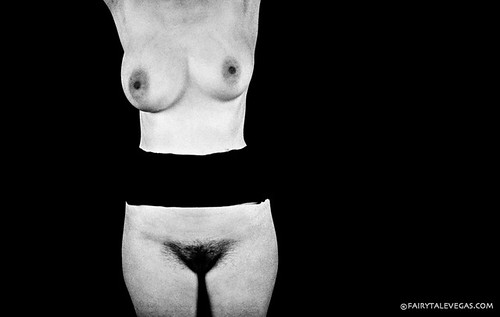
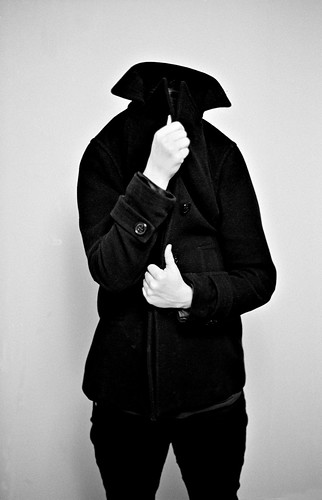
Lauren_Goldberg_Disconnect LaurenGoldberg_Distance

That Ms Goldberg has even thought to rework Man Ray instead of, say, posing for him as a model would have constituted, from Man Ray’s or his contemporaries’ points of view, a radically feminist act. Isn’t progress grand?

Meanwhile, the sensitive and gifted Cassie Olander conjures Imogen Cunningham’s Triangles and similar carnal landscapes through her photograph "Unity".
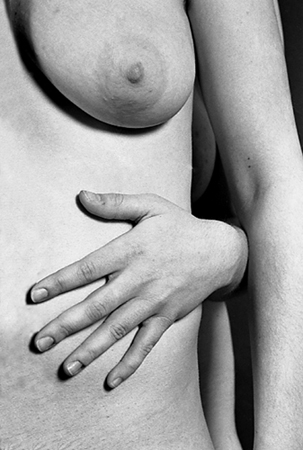
CassieOlander_pair

Cunningham was, of course, a woman as well, so the homage initially seems uncomplicated. When the viewer, however, realizes that "Unity" teasingly, almost coyly depicts two nude women locked in a soft embrace, it becomes clear that Olander is repurposing Cunningham’s lauded and, by now, canonical means to send a still unconventional, perhaps radical message.

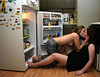
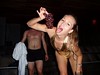
With LES, Anne Marie Hansen kills her father with rebellious joy and an almost mathematical elegance. The image is simple, powerfully so. A drunk girl in a tacky gold bathing suit dangles a bunch of grapes before her open mouth. The crook of her elbow suggestively obscures the head of a young man standing just behind her. The viewer’s gaze comes to rest on his not-yet-distended swim trunks.
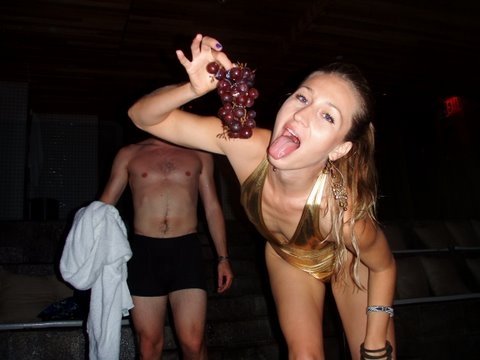
AnneMarieHansen_LES

With this image, Ms Hansen lays waste to Magritte, American Apparel ads, real pornography and countless other misogynistic portrayals of women reduced to their capacity as passive sex-recipients . . . by using their motifs and techniques to shoot a message of female sexual hunger straight down our hungry maws. (My father was quick to note that Hansen has reworked surrealist painting The Rape as The Grapes. Let the artist make of this what she may.)

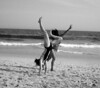
Many other photographs in the set are simply beautiful portraiture. Amanda Palmer (making one of several cameos) has bad sunburn. A pair of nimble clowns practice what looks like acroyoga. Swimmers dot the surf like foam. Progress shows subtly, like light through a lattice. Slowly, we come to understand that it is the essence of the radical (and a slap in the face to both Laura Mulvey and the men whom she rightly criticized) for these photographers merely to portray their subjects with the variegation natural to two (or more) humans playing in the light, linked and loving through a camera lens, and nobody shunned or stopped or subjugated by the process at all. Most of all, that we cannot tell by any trick that these photographers were female is, upon (another) reflection, a most gorgeous happening.

Where, then, the rhymes and reasons to this set? There are many. We can start with the most unsubtle geometry exploited to great effect by the expert artists whose work is featured here—or perhaps, given the show’s very particular theme and patterning, by their curator. To put it bluntly: sexually evocative arcs and swoops and circles, punctuated, or punctured, by the occasional blunt or slender pole, abound in the collection. The vivid plethora of ovoid-and-spike figurings conjure an almost subliminal, spooky mentation reminiscent of Charles Burns’ Black Holes, which turned the vulva-shape into a repeated signifier of horror, a foreshadower of doom nested in appearances of the unexpected—such as a dissected frog’s back, a cut wrist, a lake where children skinny-dip. (Really, if you haven’t read a copy yet, you must—it’s the rare graphic novelist who can make the vulva into a Lovecraftian destroyer of worlds, and absolutely terrify you to pieces with it, and then make you cry.) I leave the viewer to pick his or her own incautious, revelatory path through the darkling bogs and brambles that litter the track of Girleye with a beauty, and a stillness, and danger.

Additionally, and flowing nicely from my bogs’n’brambles metaphor if I do write-so myself, bathing imagery pervades the show. Including the web-only images, roughly one sixth to one seventh of the pieces either allude to bathing or actually feature a nude lady bather or set of bathers. Factor in the joyous lesbian kissing, lesbian sex, and—let’s face it, people—lesbian hairstyles on display in several of the other photographs, and the images of happy women cavorting in water take on a rawer, sexier connotation.

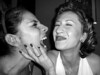
In fact, the show seems to posit the old Radicalesbian message that one of the most authentic ways for women to relate to one another happily as women is by the art of sexual love. In Anne-Marie Hansen’s "Naughty",
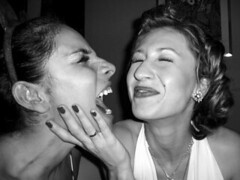
AnneMarieHansen_faces

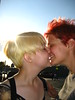
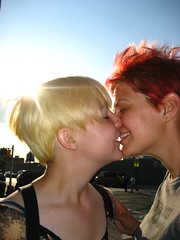
a seemingly drunken reveler tilts a frenemy’s chin toward hers in a parody of sexual love, a parody that conceals revulsion. Immediately, for your own psychological wellbeing if for no other cause, contrast this deeply discomfiting (though beautifully done) image with Beth Hommel’s soothing Kiss,
Beth_Hommel_18_Kiss

a gentle expression of adoration between women who are real lovers, at least for the moment the camera saw.

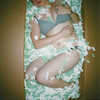
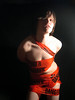
Speaking of sex, or politics, or merely the bonds imposed, displaced, ignored or adored by the act of looking: a teasing kind of bondage pervades the images of Girleye. Cassie Olander wraps one subject in a dress of loose bondage tape marked “DANGER”, and another in what looks like a symbolic bracelet of packing tape about the upper arm. Allison Green wraps two nude females against one anther in a web of loose bondage tape that looks a bit like toilet paper or crepe streamers. One thing is clear—these bonds aren’t holding anybody anywhere. Are they jokes, suggestions, denials, teases? On or of the viewer, always—the bondage never holds the subject, in these photos. Greene also photographs two straight lovers turned away from each other in a scarlet bed, a strip of pure white tape pasted across their snuggly bods. The photographer seems to suggest that the bonds—of love, sex, of matrimony, for all we know—that hold these lovers together are as flimsy as the tape she has strewn atop them. (A commentary on the “sanctity” of marriage? Or just of young lusts?)

One rather wishes that curator Janet Bruesselbach’s work had been featured in this show. Indeed, the images seem to have been selected so that, en masse, they resemble one of her massive artworks. With her physics-defying, anatomically incorrect oil orgies and other acts of sly painterly nihilism, Bruesselbach has assembled a career out of teasingly cinching and severing the ties of artist to subject, subject to viewer, male to female, armpit to elbow and whatever else you can think of, always with an eye to disassembling old theory and provoking transformation. The child of two eccentric physicists forever rusticating in one of the more precarious reaches of the rarefied Malibu wasteland, Bruesselbach understands difference with anything but difference, and from more angles than even her most multiply valenced works could invite you, dear Reader, to contemplate.

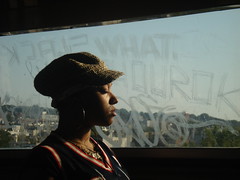
So it is surprising and perhaps offensive, with all the above dimensions of diversity in mind from both curator and photographers, that all the subjects of Girleye (minus one) are white. One doubts that the artists of Girleye have conspired to constrict the scope of femininity to a single, whitewashed point. Rather, the show evidences by strong implication that the photographers simply don’t hang out with many people who aren’t white. Even Hommel’s Mail Order, a seeming send-up of (Third World, usually nonwhite) mail-order brides, features a white subject as the mailed party. The only actual nonwhite subject in the entire set appears to be a stranger to the photographer (Hansen in this case). Most other subjects meet Ms Hansen’s gaze with ease, evincing familiarity if not friendship. Her lips parted slightly, this subject gazes straight ahead, meditating to the music on her iPod as she wills the subway ride to be over. She appears to be a stranger whom Hansen happened to snap on a long train ride. The image is remarkable for its ordinariness, its emotional opacity. Hansen never knew her subject’s story and, therefore, we viewers will never know it, either.
AnneMarieHansen_FTrain

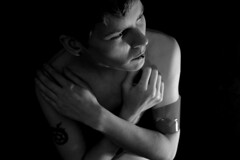
Another note on difference: one wonders if artist Cassie Olander’s male-presenting subjects Liz and David (and I mean to mark the subject named David especially) would especially desire their images used in a collection of women who are nominally looking at women. The above are also two of the only brooding subjects in the entire show, and their haunted eyes shy from the camera’s shutter, leaving us only with the impression of hunched shoulders and obsessively pomaded hair. Hardly a representative image of butch or—more appropriately—trans moodiness, unless these two just started on their testosterone regimen, in which case, of course, all bets are off (just kidding!). I for one am willing to believe that Ms. Olander accurately captured sad moments in the lives of these two subjects, and from Olander’s other, also beautifully felt work must believe that Olander selected these moments, not to portray transmen as a sad breed generally but to show us the sadness of the falling cherry blossoms, as they happened to fall.

CassieOlander_david CassieOlander_liz3

Maybe David and (probably) Liz are not transmen in the first place, but playful young women who happened to butch it up for their respective shoots. Maybe, maybe. But maybe not. What if they are transgendered? What if they really aren’t women? What if they hate the very idea of being included in this show? Well, have I got an interpretation for you.

Noted drag warrior and gender obscurist James St James writes wisely in his novel Freak Show (if you will allow me, dear Reader, to extend and wriggle a bit in this authorial stretch) that the transfolk of our society are trammeled and trashed by the violent misapprehensions of our culture, but the very chains (of thorns or flowers, of iron or of gold) that yoke transfolk into endocultural conflict enable them to act as revolutionary agents, and aching reminders of the impermanence of “fates”.

If this were a slightly academic article and not a (bl)o(g)nanism, I’d write some lameass transition phrase like:

If my interpretation of St James is to be believed, we may celebrate Girleye’s inclusion of transmen—not for the men’s futures qua men, but for the intersection of their futures with their girlish pasts. Or, to misappropriate the oft-appearing Amanda Fucking Palmer, girls will be girls will be boys with no warning. Such transitions imply a potential for our own . . . into boys, into women, into whatever the hell we want, be it sexes or genders or any of the manifold wondrous identities that lie not between our legs but in our lives.

Trans is Latin for across, after all. It would be great if transmen, biowomen, and everyone in between could appreciate the plenitude of identities open to them throughout their lives. And that’s just what this show is for. Let us embrace David, Liz, and all the rest with open arms and mouths and water-forms, and hope that perhaps they like us, too, just a bit at least . . .

On that note, let us close by oh so gleefully misusing a monster quote from that master of misuse, and of potential-play, Donald Barthelme, masquerading here under the voice of a woman impregnated with a fetus by three men—in our interpretation, a woman who becomes us, impregnated with transformative potential by the girls of Girleye:


The engendering force was, perhaps, the fused glance of all of them. From the millions of units crawling about on the surface of the city, their wavering desirous eye selected me. The pupil enlarged to admit more light: more me. They began dancing little dances of suggestion and fear. These dances constitute an invitation of unmistakable import—an invitation which, if accepted, leads one down many muddy roads.


I accepted. What was the alternative?

9

Saturday, April 03, 2010

The Girleye Show

The Girleye Show


April 3-30, 2010

Tribes Gallery 285 E 3rd St. 2nd Floor NYC 10009
Beth Hommel is a photographer and multimedia artist originally from Vandergrift, Pennsylvania. Her primary focus is the creation of truthful, unusual portraits. Her work has been seen in magazines and newspapers worldwide, and more than a dozen of her photographs were included in Who Killed Amanda Palmer: A Book of Photographic Evidence, which she also designed. She lives in Brooklyn with her partner Kayla.

View more at www.bethhommel.com


Beth_Hommel_04_10AM
Beth Hommel

Before 10 am

16x20

$300


Beth_Hommel_13_Sarah
Beth Hommel

Sarah

11x17

$200


Beth_Hommel_15_Cello
Beth Hommel

Cello

11x17

$200


BethHommel_Kitchen
Beth Hommel

Kitchen

11x17

$200


Beth_Hommel_07_Palms_and_Knees
Beth Hommel

Palms & Knees

11x17

$200


Beth_Hommel_14_Sunburn
Beth Hommel

Sunburn

8x12

$200


Beth_Hommel_10_Courage
Beth Hommel

Courage

8x12

$150


BethHommel_Caress
Beth Hommel

Caress

8x12

$150


Beth_Hommel_03_Rooftop_Waltz
Beth Hommel

Ripples II

8x10

$100


Beth Hommel

Murder Was The Case They Gave Me

8x10

$100


Beth_Hommel_06_124
Beth Hommel

125

8x10

$100


Beth_Hommel_11_Casey
Beth Hommel

Casey

8x10

$100


Beth_Hommel_02_BlueBeth_Hommel_01_Red

Beth Hommel

Red & Blue

$150


Beth_Hommel_05_Fingers_Crossed
Beth Hommel

Fingers Crossed

5x7

$80


Beth_Hommel_17_Light
Beth Hommel

Light

5x7

$80


Beth_Hommel_18_Kiss
Beth Hommel

Kiss

5x7

$80


Beth_Hommel_09_Mail_Order
Beth Hommel

Mail Order

4x6

$50


Anne Marie Hansen


AnneMarieHansen_Sky
Anne Marie Hansen

A Soho Sky

11x14

$150


AnnMarieHansen_ice
Anne Marie Hansen

Ice

8x10

$150


AnneMarieHansen_self
Anne Marie Hansen

Miss Mercier

8x10

$100


AnneMarieHansen_faces
Anne Marie Hansen

Naughty

8x10

$100


AnneMarieHansen_cartwheel
Anne Marie Hansen

Beach

5x7

$100


AnneMarieHansen_silouette
Anne Marie Hansen

Jump Rose

8x10

$100


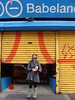
AnnMarieHansen_babeland
Ann Marie Hansen

Babeland at 10 am

5x7

$100


AnneMarieHansen_LES
Anne Marie Hansen

LES

5x7

$100


AnneMarieHansen_swimmers
Anne Marie Hansen

Katonah Swimmers

8x10

$80


AnneMarieHansen_FTrain
Anne Marie Hansen

F Train

5x7

$100


Anne Marie Hansen

Wedding Day

5x7

$100


AnneMarieHansen_DeckofCards
Anne Marie Hansen

A Deck of Cards

5x7

$60


AnneMarieHansen_grin
Anne Marie Hansen

Lady Lily

5x7

$60


Cassandra Olander resides in Brooklyn, New York and has been a photographer for several years. She has had over 50+ photographs published in Curve, InsideOut, She and GoNYC Magazine, including online features. Her style concentrates on black & white portraiture from a feminist and/or queer perspective. View more at cassandraolander.com


CassieOlander_tank - danger
Cassie Olander

Danger

8x10

$125


CassieOlander_tank - silver
Cassie Olander

Reaching

8x10

$125


CassieOlander_pair
Cassie Olander

Unity

5x7

$100


CassieOlander_tank - silver2
Cassie Olander

Silver

8x10

$125


CassieOlander_david
Cassie Olander

Vulnerability

8x10

$125


CassieOlander_liz3
Cassie Olander

Contemplative

8x10

$125


CassieOlander_w15
Cassie Olander

Reflect

8x10

$125


CassieOlander_wazina - bathtub
Cassie Olander

Bubbly

8x10

$125


Lauren Goldberg is photographer based in New York City. Lauren specializes in band and fine art photography. Aside from photography, she works on film and video, as well as graphic design, silkscreen, painting and drawing, and as many other forms of art as possible. She is attending the School of Visual Arts as of Fall 2009 for photography.

Her work is at fairytalevegas.com


LaurenGoldberg_CryingStatue
Lauren Goldberg

Crying Statue

20x30

$300


Lauren_Goldberg_Disconnect
Lauren Goldberg

Dismemberment

20x30

$300


LaurenGoldberg_Looking
Lauren Goldberg

Through the Looking Glass

20x30

$300


LaurenGoldberg_DAFP
Lauren Goldberg

Dead in the Garden

11x17

$250


LaurenGoldberg_Hand
Lauren Goldberg

Hand

11x17

$200


LaurenGoldberg_Distance
Lauren Goldberg

Distance

11x17

$200


LaurenGoldberg_Reflection
Lauren Goldberg

Reflection

11x17

$200


LaurenGoldber_Stairs
Lauren Goldberg

Stairs

11x17

$200


LaurenGoldberg_Arch
Lauren Goldberg

Arch

8x12

$125


LaurenGoldberg_reach
Lauren Goldberg

Reach

8x12

$125